
Buying Guides6 min read
Custom-Fit Car Sun Shades in Australia: What You're Actually Paying For
There's a moment most people have with a universal sun shade. You've stretched the sock over the rear door, it looked fine in the driveway, and then you glance in the mirror on the way to school and there's a bright wedge of sunlight sitting directly on your kid's face. The shade is technically on the window. It's just not covering the part that matters.
That gap is the whole argument for custom-fit.
Why car windows defeat generic shades
A rear door window is almost never a rectangle. It has a curve along the top where the frame follows the roofline, a kink at the back where the quarter glass meets the door, and on most SUVs a beltline that rises from front to back, so the shape isn't even symmetrical front-to-rear on the same car.
A universal shade is cut as a rectangle, or stretched over one. Either way, the corners are where it fails. Those corners are also the highest point of the window, which is exactly where low afternoon sun comes in.
The second failure is attachment. Suction cups need clean glass, they soften above about 50°C, and a parked car in an Australian summer comfortably exceeds that. They fail on the day you need them. Stretch socks bunch the moment the window moves or the door slides. Static cling is permanent in practice, because nobody re-applies it once it's peeled.
What custom-fit actually means here
Every shade is cut for one vehicle's exact door aperture, by make, model and year bracket. That's not a marketing distinction — it's why there are separate patterns for a Ford Focus hatch and a Ford Focus sedan, and separate patterns again for the 2007–2013 and 2014–2020 versions of each.
We currently hold 474 vehicle fits, across Toyota, Hyundai, Kia, Mitsubishi, Ford, Honda, Mercedes, Nissan, Mazda, BMW, Lexus, Holden and others.
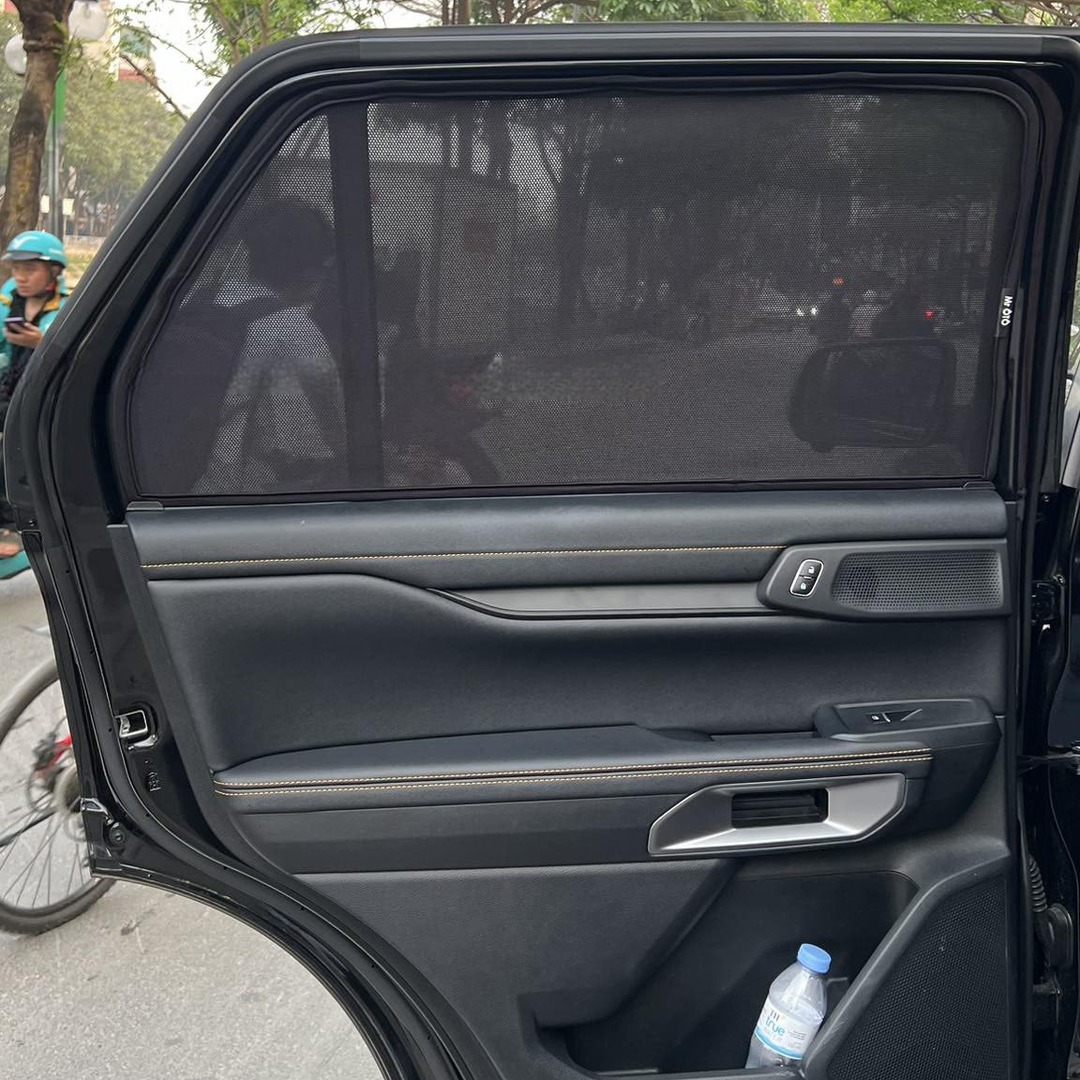
Look at the edges in that photo rather than the middle. The mesh finishes against the frame the whole way round, including the top corners, and it follows the curve rather than cutting a straight line across it. That's the difference you're paying for.
And look through it. You can read the street, the parked cars, the mirror. Rear passengers keep their view out, which matters more than people expect — kids who can't see out get carsick, and a blacked-out rear window is the fastest way to a miserable drive.
The attachment
A flexible magnetic edge, sewn into fabric, grips the painted steel frame around the window. It never touches the glass.
Practical consequences of that, in rough order of how often they come up:
- The window still winds down with the shade fitted.
- Nothing is left on the glass — no rings, no residue, no adhesive.
- Factory or aftermarket tint underneath is unaffected.
- Heat doesn't weaken it, because there's no vacuum to lose.
- It comes off in about a second when you want it gone.
One genuine limitation: it needs steel. A small number of vehicles use aluminium door frames, and magnets won't hold on those. If you're unsure, hold a fridge magnet against the painted frame around your rear window before ordering.
What it costs
Sets are sold by position, so you can shade only the windows that need it.
| Set | Pieces | Price |
|---|---|---|
| Front door windows | 2 | $49.99 |
| Third-row side windows | 2 | $49.99 |
| Rear door windows | 2 | $59.99 |
| Boot / tailgate window | 1 | $59.99 |
| Front and rear door windows | 4 | $99.99 |
| Rear doors + third row | 4 | $99.99 |
| Rear doors + boot window | 4 | $109.99 |
| Front and rear doors + third row | 6 | $145 |
| Front and rear doors + boot | 6 | $155 |
| Complete set, every window | 8 | $189 |
Not every set exists for every car. A five-seat hatch has no third row; a dual-cab ute has no boot glass to shade. The model page lists what your vehicle actually takes.
Which set to buy
The order that gets you the most for the least, for most Australian cars:
Rear doors first. This is where the child seat is, where the dog sits, and where nobody can move out of the sun. It's also legal to drive with fitted, which the front pair isn't.
Then the boot or tailgate glass, if you drive a hatch, wagon or SUV. It's the largest piece of unshaded rear glass on the car and the reason your boot is an oven after two hours nose-in at the shops.
Then the third row, if you have one and anyone sits in it. That row is furthest from the vents with the smallest windows, and it's the row people complain about.
Front doors last. You're sitting there, you can move, you have a visor, and you have to take them off before you drive anyway.
The common mistake is buying the four-piece front-and-rear set because it looks like the complete option. On a seven-seater it isn't — it leaves the hottest row in the car completely unshaded.
Custom-fit versus tint
They solve overlapping problems and people treat them as alternatives when they're not.
Tint is permanent, regulated by a measurable light-transmission figure, and just as dark at 7am in July as at 2pm in January. It's assessed at roadworthy inspection. It also does comparatively little about radiant heat, because the film is bonded to the glass that's doing the heating.
A shade sits in front of the glass, comes off in a second, and isn't subject to the tint rules at all — it's judged on whether it obstructs the driver's view. On a car that already has film, adding rear-door shades is the combination that actually changes how the back seat feels.
We've written the position-by-position rules up in the state-by-state legal guide.
Stock and lead times
Roughly a quarter of the range is held in stock and ships from Sydney. The rest is made to order on a one-to-two week lead time. Both are faster than importing from overseas, but they're different waits, and it's worth checking which one your vehicle falls into before you plan around it.
About the figures
UV-blocking and temperature numbers for the mesh come from our manufacturer and describe the fabric, not a whole-vehicle test. They aren't independent laboratory results, and real-world performance shifts with your glass, your tint, where you park and what the weather is doing.
What doesn't need a qualifier is the geometry. A shade cut to your door aperture has no corner gaps. A rectangle stretched over a curved window does. That difference is visible in every photo on this site, and it's the one that decides whether the sun lands on your passenger.
Find your vehicle
Search the full range by make and model — 474 fits and counting. If yours isn't listed, send the make, model, year and VIN and we'll tell you whether the pattern exists or where it sits in the queue.
Related reading
- Which rear windows actually matter
- Are car sun shades legal in Australia?
- Windscreen shades: what actually works
Prices and stock correct at August 2026.
Ready to fit yours?
Custom-fit sun shades, made to your car's exact windows.
Can't find your car? Message your car model on WhatsApp