
Buying Guides8 min read
School Run Car Window Shades: The 3pm Drive Home
Our baby articles cover capsules, newborns and rear-facing seats. If that's where you are, start with the best car shades for babies and are car window shades safe for babies?. This one is for the next stage: boosters, school bags in the footwell, and two trips a day at the same times, five days a week, for years.
That routine is what makes the school run worth thinking about on its own. A car that sits in the same spot at pickup and heads home the same way every afternoon puts the sun on the same window every day. Find that window and you've found most of the problem.
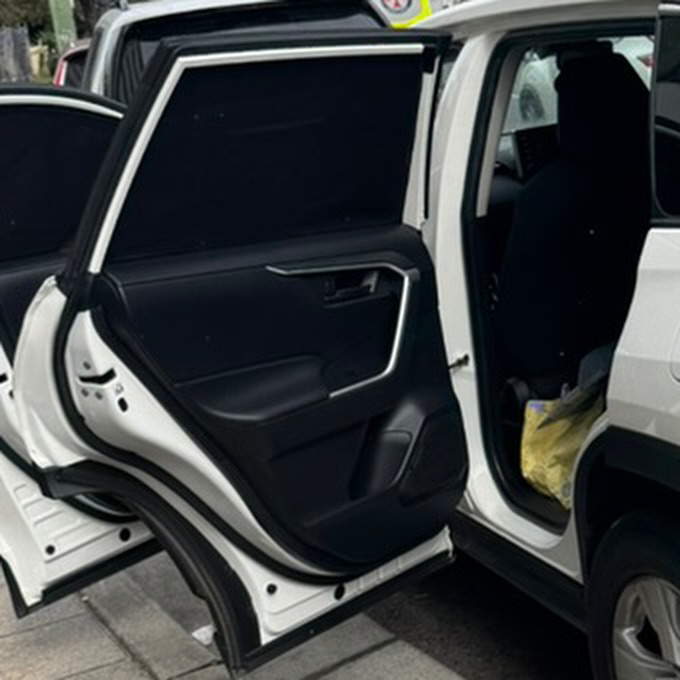
Where the sun is at pickup
At 3pm the sun is in the western half of the sky. Which rear door it hits depends on which way you drive home. We drive on the left, so:
- Heading north, west is on your left. The sun comes through the kerb-side rear door, the passenger side.
- Heading south, west is on your right. It's the rear door behind the driver.
- Heading east, the sun is behind you. It comes through the tailgate glass and, on most SUVs and wagons, the small quarter windows behind the rear doors. That lands on the back of a child's head and neck.
- Heading west, most of it comes through the windscreen, and a rear shade does less.
Real routes bend, so the test is simpler than any rule: one sunny afternoon, sit in the back seat at pickup time and see which glass the sun comes through. Our page on which car windows to shade goes through each position.
Term 1 and Term 4 are not the same as Term 2 and Term 3
The season changes the problem. In Term 4 and Term 1 the afternoon sun is still high at pickup, so it lands on laps, legs, seats and buckles more than in kids' eyes. That's the hot-seat half of the year.
In Terms 2 and 3 the afternoon sun is lower and comes more directly through the side glass, at face height. That's the squinting half. Both are side window problems, which is why a shade on the rear doors works across the whole school year.
Daylight saving moves it again. NSW, Victoria, South Australia, Tasmania and the ACT put the clocks forward in summer, so a 3:15 bell there is earlier by the sun than the same bell in Queensland, Western Australia or the Northern Territory.
Where the kids sit, and why the booster matters
Seating is set by law, and the details are worth knowing because they decide which window your child is beside. The NSW Government's child car seat rules say children under 7 must be in an approved child restraint. From 4 to 7 that's a forward-facing seat with an inbuilt harness, or an approved booster. Children 7 and over who are too small for a seatbelt should keep using a booster, and the suggested minimum height for an adult lap-sash belt is 145cm. Children aged 4 to 7 can't sit in the front of a car with two or more rows unless the back seats are taken by other children under 7. Those are the NSW rules; check your own state's transport authority for yours.
In practice, that means most primary school kids ride in the back, on a booster, beside a rear door. A booster lifts a child so the belt sits right, and it lifts their head higher in the window too. Two things follow:
- The top of the glass matters. A shade that stops short of the frame leaves a strip of sun right at a booster-height child's eyes.
- The quarter glass matters more than it does for adults. On a lot of SUVs, the small fixed pane behind the rear door is close to where a child's head sits on a booster. It's the window most people don't cover. There's a page on quarter and third-row glass if you're not sure your car has it.
Then there's the kerb. Kidsafe SA's hot cars fact sheet advises taking children out of the car on the safe side, away from traffic. So it makes sense to seat the child who gets out at the gate behind the front passenger. If your drive home heads north, that's also the sunny side.
Shades kids can see through
For school-age kids we nearly always suggest mesh over blackout. Older kids want to look out. They spot their mates, read the signs, see where they are. A see-through mesh cuts the glare and keeps direct sun off their skin without turning the back seat into a cave. You can also still see them over your shoulder and in the mirror.
That's in line with the official advice. Kidsafe Victoria's hot cars fact sheet suggests a visor or sunshade on the vehicle glass if young children need protecting from sun through the car windows. Cancer Council Australia's tinted windows fact sheet says fabric side window covers can give shade and UV protection, that it varies between products, and that covers and tints only work with the windows closed. That last point is the school-run catch. If your kids ride home with the window down, the UV benefit goes. Our UV guide has the detail on what side glass lets through.
The car has been sitting in the sun all day
The car that does the pickup has often been parked since the morning drop-off, sometimes at work, sometimes in an open car park. By 3pm the seat and the buckle beside the sunny window have been in direct sun for hours.
- Leave the rear shades up while it's parked. The seat and buckle behind a shaded window stay more comfortable to touch.
- Check the buckle before you clip them in. The back of your hand on the metal tongue takes a second.
- Keep water in the car for the trip home, as Kidsafe Victoria's sheet recommends for summer trips.
And the one that has nothing to do with shades. Kidsafe SA puts the inside of a parked car at 20 to 30°C hotter than the outside air, with most of that rise in the first five minutes. Shades don't change that. If you need to duck into the shop on the way home, take the kids with you.
Which set for the school run
On our listings the rear door pair is $59.99, and for most school runs it's the whole answer. Add the quarter or third-row glass ($49.99) if the sun gets in behind a booster. Add the tailgate glass if you head east and the sun comes in from behind. Rear doors and tailgate together are $108.99 on the cars we cut it for. The front pair ($49.99) is for parking only. Take it off before you drive. The legal guide covers the rules in each state.
Some common school-run cars we cut:
- Toyota RAV4, Mazda CX-5 and Hyundai Tucson: mid-size SUVs with quarter glass behind the rear door on the current shapes we cut.
- Kia Sportage and Nissan X-Trail: check your generation's listing for which windows are cut.
- Kia Carnival, Kia Sorento and Mitsubishi Outlander: seven-seaters. Third-row glass is cut for the 2020 to 2026 Carnival, the 2011 to 2020 Sorento and the 2012 to 2021 Outlander, but not the 2021 to 2025 Sorento. If you run a carpool and the back row gets used every day, cover it.
Sets are cut per generation, so match your build year to the listing. Which generation is my car? shows how, or send us a message with your build year and model.
Questions parents ask
Can the kids put the shades up and take them down? Older primary kids usually can. The panels sit in the window frame, not on the glass. It's still worth an adult checking that they're seated properly before you drive.
Will a shade stop my child getting sunburnt on the way home? Side glass already blocks most UVB, which is the burning part. A shade adds cover against the UVA that gets through, and it stops the direct sun and glare. It's one part of sun protection, alongside the hat and sunscreen they wear at school anyway.
Should I take them off in winter? There's no need. In Terms 2 and 3 the low afternoon sun is at its most annoying. Take the rear shades off for night driving if they cut your view out the back.
What about the front passenger seat? Primary school kids aged 4 to 7 shouldn't be in the front in a car with a back seat, under the NSW rules above, unless the back is full of younger children. For anyone in that seat, front shades are for a parked car only.
For how the heat differs from Darwin to Hobart, see summer car heat by state.
Ready to fit yours?
Custom-fit magnetic sun shades, made to your car's exact windows.
Can't find your car? Message your car model on WhatsApp