
Search "rear window sun shade" and you get three different products dressed up as one: a roller blind for the boot glass, a cling panel for the back door, and a cut-to-shape mesh set for either. They are not interchangeable, and buying the wrong one is the usual reason a shade ends up in the glovebox instead of on the window.
The back of a car is not one window. This page breaks it into the positions that actually exist, says what each one needs, and shows you how to pick a set without buying the lot. One number to hold onto while you read: across every car we sell, the rear door pair on its own is more than half of all orders. The complete set, every window, is a small minority. Most people are solving one problem, and it is usually the back seat.
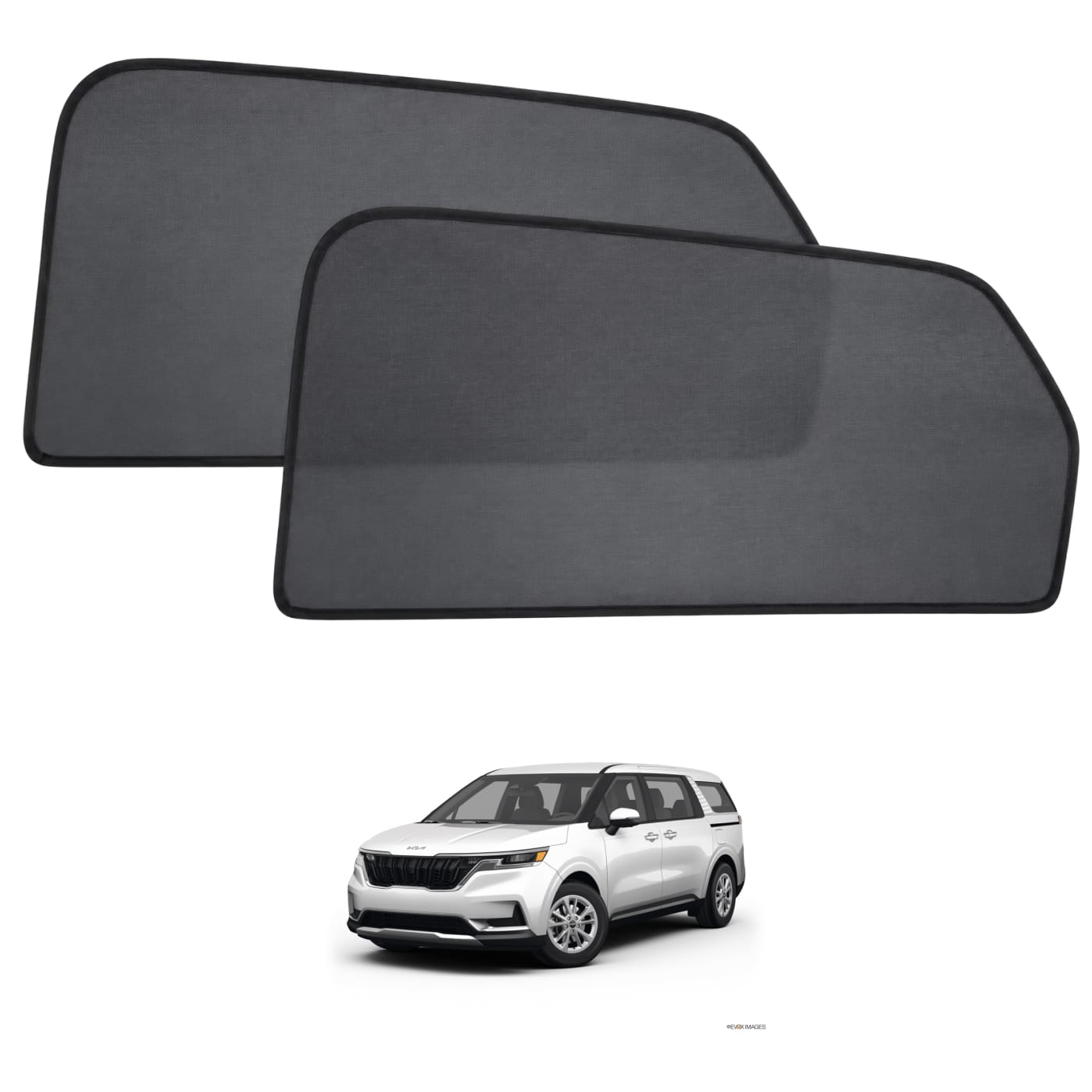
The four positions
| Position | What it is | Why it needs its own shape |
|---|---|---|
| Front door windows | The driver's and passenger's glass | Cut back at the mirror so the driver's view is kept; for a parked car, not for driving |
| Rear door windows | The two windows the back seat sits beside | They wind down, so the shade has to work on a moving pane inside a steel frame |
| Quarter or third-row glass | The small fixed panes behind the rear doors | Irregular, often triangular, and never covered by a universal panel |
| Boot or tailgate window | The glass in the hatch | Fixed, steeply raked, wider than it is tall, and surrounded by trim rather than a steel lip |
A universal "rear window shade" is cut for one of these and fudged onto the others. That is where the bright edges come from.
Which one is causing your problem?
- Kids squinting or overheating in the back seat — the rear door windows. This is the position that does the work and, oddly, the one people most often buy last.
- A pram, tools or a dog cooking in the back — the boot glass. A cargo question, not a passenger one.
- Passengers in the third row of a seven-seater — the third-row glass, which nothing off the shelf covers. If the third row is folded flat and used as boot space, skip it.
- A wedge of light at the back of the cabin on an SUV — the quarter pane behind the rear door. Same set as the third row on our listings; there is a page on why the shop names it that way.
- The car is an oven when you get back to it — the front pair, for the parked car. Take them off before you drive.
Sit in the back seat at the time of day you actually drive and note which glass the sun comes through. That is the set to buy.
Rear door windows: the position that does the work
The rear doors are where the afternoon sun lands driving north or west, and they are the only rear position where the glass moves. Three things matter:
- Frame-mounted, not glass-mounted. Anything stuck to the glass comes off when the window goes down. A magnetic edge sits on the painted steel of the door frame, so the window still operates underneath it.
- Full height. A shade that stops short of the top of the frame leaves a bright strip at eye level for a child in a booster seat.
- Mesh, if anyone in the back needs to see out. Mesh cuts UV, glare and heat while keeping the view — which also means you can still see your passengers in the mirror. Blackout is the right call only when sleep or privacy matters more than visibility.
On our sets the rear door pair is $59.99 and covers the whole door; the front pair is $49.99 and is cut back to leave the mirror view.
The boot window: the one everyone forgets
Boot glass is an awkward shape — wide, short, steeply angled, framed by plastic trim — and it is the piece of glass that turns a loaded boot into an oven on a summer afternoon. If you tour, camp, carry a dog or run a work vehicle with gear in the back, this is worth adding. On the vehicles where we cut it, the tailgate panel is $59.99 on its own or $109.99 bundled with the rear doors.
Third-row and quarter glass
Seven-seaters — Carnival, Sorento, Everest, LandCruiser 200 and 300, Prado — have a third row of side glass that a universal shade will never fit. Mid-size SUVs like the Sportage, Seltos and Forester have a smaller fixed pane in the same place. We cut both as a $49.99 pair, and it is available on the listings where the car has that glass — the product page lists what is there. Not every seven-seater has a third-row cut yet; the MU-X, for instance, is door pairs only for now.
Mounting: what survives an Australian summer
| Mount | Holds at 40°C+ | Works with the window down | Marks the glass |
|---|---|---|---|
| Magnetic, on the steel frame | Yes | Yes | No |
| Clip, on the trim | Yes | Partly | No |
| Suction cup | Often lets go | No | Over time, yes |
| Static cling | Often lets go | No | No |
Suction cups and static cling are the two mounts that reliably let go on a hot day, and a shade on the floor blocks nothing. There is a longer comparison of magnetic and suction-cup mounting if you want the detail.
Is it legal?
Rear side windows and the boot glass are the positions where shades are generally accepted, provided the driver's view is not obstructed and the car still meets the rear-vision rules in your state. The windscreen and the front side windows are a different matter while driving; the front pair is for the parked car. The rules are set by each state and territory rather than nationally, and we have summarised them.
Picking the set
- Note which glass the sun comes through when you are actually in the car.
- Decide whether the boot needs covering. That is usually about cargo, not people.
- If you have a third row and use it, add the quarter glass.
- Take the matching set, not the full set by default. Positions can be added later, and every set on the same listing is cut from the same pattern.
Three examples of how that plays out:
- Kia Carnival — eight seats, so rear doors plus third-row glass if the back row is in use, and the tailgate panel if you tour loaded.
- Kia Sportage — a rear door pair covers most of the problem; the quarter pane is the second thing people add.
- Toyota LandCruiser 200 or 300 — every position is available, and still most owners start with the rear doors.
You do not need a tape measure for any of it. The pattern already exists for your car; what you are deciding is which positions to cover. If you are not sure which listing is yours, that is a generation question rather than a window one, and it has its own guide.
Questions we get
Can I leave rear door shades on while driving? On the rear passenger windows, yes — that is what they are for. Take them off for sustained highway speeds. Never fit a shade to the windscreen or front side windows while the car is moving.
Will a rear door shade fit the boot window too? No. Different shape, different mounting surface, different panel. They are sold separately for that reason.
Do I need the full set? Usually not, and the order book says so. Most people are solving one problem and the matching pair does it.
Mesh or blackout for the back? Mesh if passengers need to see out or you want to see them. Blackout if the priority is a sleeping infant or privacy in a parked car.
Ready to fit yours?
Custom-fit magnetic sun shades, made to your car's exact windows.
Can't find your car? Message your car model on WhatsApp